Plynlimon – source of Rivers Severn, Rheidol and Wye – a pilgrimage

On St John’s Day, 24th June 2026, a long wished-for dream was fulfilled when a group of us went to the birthplace of the ‘three sisters’ : the rivers Rheidol, Severn and Wye. At 752 m (2,647 ft) elevation, Plynlimon, the highest point in the Cambrian mountains, is a sacred mountain giving rise to the UK’s longest river. The waters bubble up through the peat on the moorland plateau and flow off in a few directions to form the Rheidol who flows out west to Aberystwith; the Wye who meanders across country and meets the river Severn just below Chepstow at the Severn Estuary; and the Severn who tumbles and rushes powerfully into the Severn Estuary and then into the Bristol Channel and out to sea. Shrewsbury, Ironbridge, Bridgnorth, Bewdley, Stourport-on-Severn, Worcester, Tewkesbury and Gloucester are key towns along her 225 mile route, all powered and fed by her waters.
There are several groups along the Severn who, in common with many communities across the UK, are rising up in guardianship of their local river. I went with Sacred Severn and Monica Feria-Tinta, whose idea it was to go to the source as she is inspired by the river Severn and we had instructed her to give legal advice about protection of the bore. ZDF filmed our ascent and ceremony because they are making a documentary about rights of nature worldwide and visiting 12 countries, following Monica’s work.
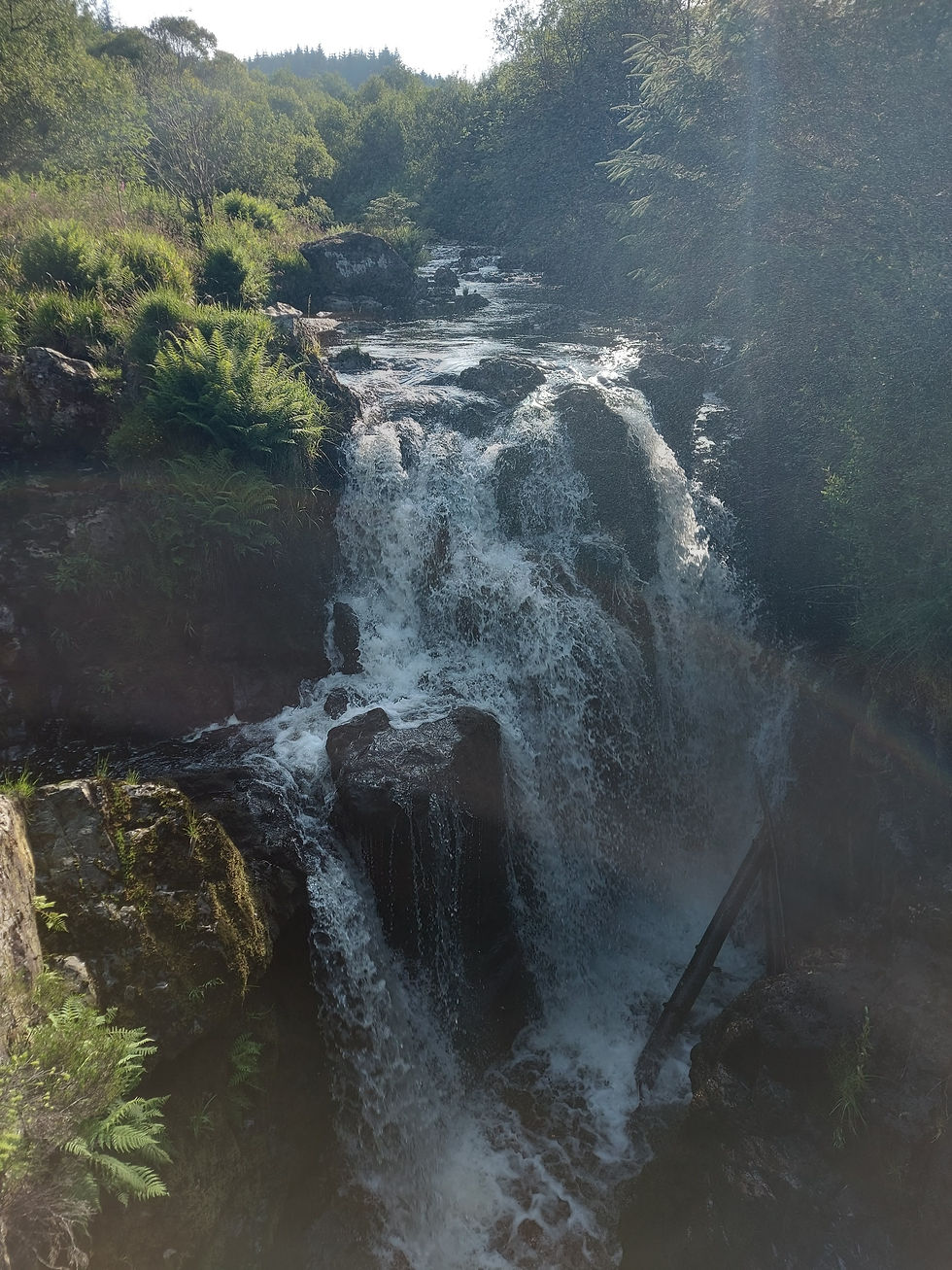
On the first evening we were taken to Severn Break its Neck Falls, a magnificent waterfall whose brackish waters threw up a sea-scented mist. We made our first offering of greeting to river Severn and cast some birch bark, upon which we had written some intentions, to the waterfall.
The following day on St John’s Day, 3 days after the Summer Solstice, we hiked up a beautiful gorge, shaded by trees, with wild flowers, birds, butterflies and dragon flies flitting about, the river Severn’s waters tumbling over waterfalls and filling fairy pools amongst the huge boulders, making offerings along the way, greeting the river and ascending to her source. The plateau at the top is flat and unshaded which was challenging in a heatwave but the altitude meant that the temperature was manageable enough for us to walk across the moorland to the spring where the Severn starts.
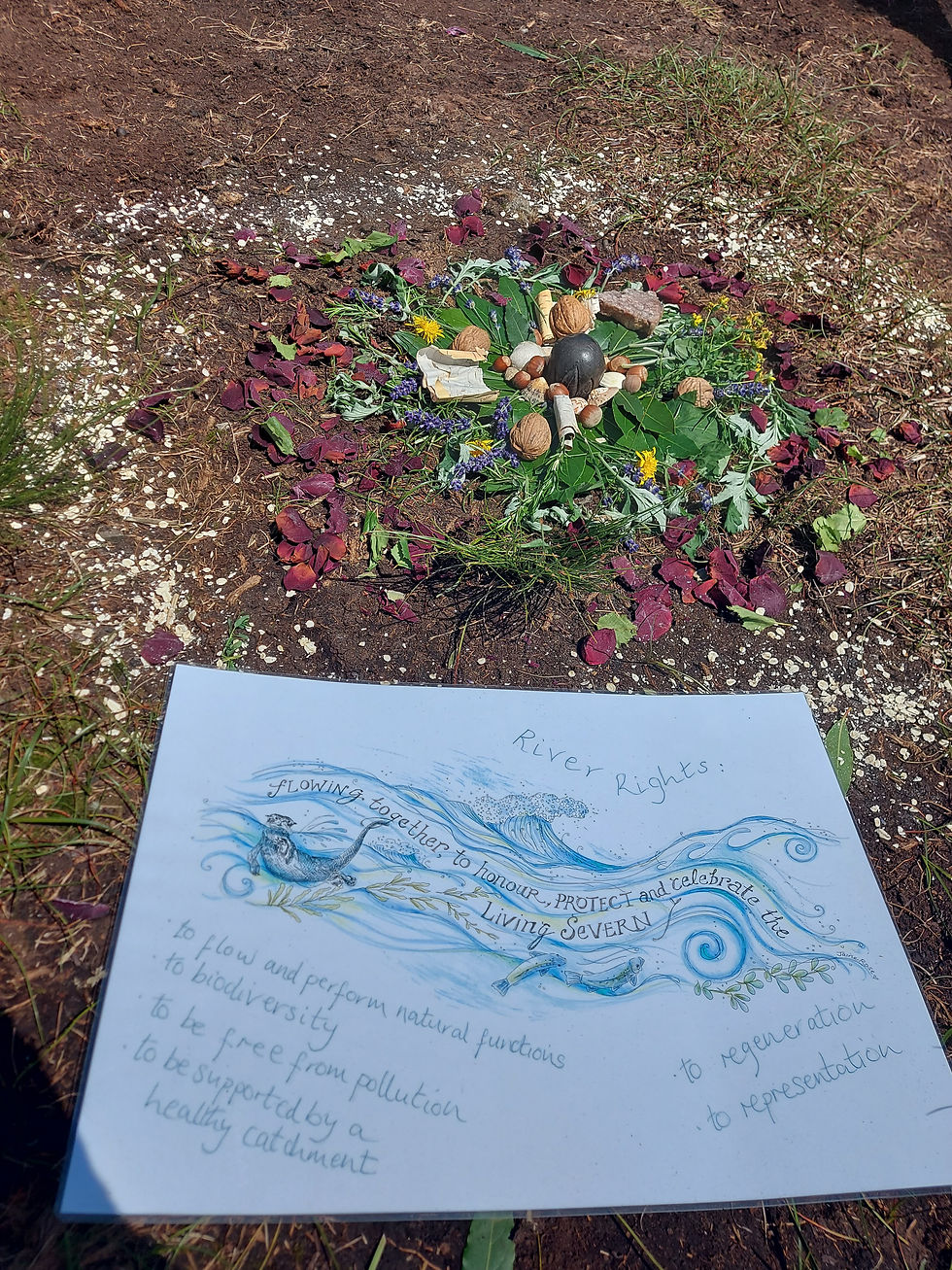
We spent some time tuning in, speaking in ceremony about the importance of this river, the sacredness of the land and water, and expressed our thoughts and feelings about the state of the UK’s rivers and our commitment to river guardianship. We laid a mandala of flowers and placed shells and other natural objects to symbolise and carry our blessings. While we were making our offerings there was a loud gurgle which everyone including the cameraman heard and which to us sounded like the water responding to our presence!
We then started the descent and when I stopped at a waterfall, the abundant, joy-inducing water filling up pools and flowing over rocks made me say to it ‘you give me hope’; my next thought was ‘who am I not to have hope?’ And this reflection reminded me of Robert Macfarlane’s words when he says that hope is a discipline and despair is a luxury.
On the way back down Monica and I got waylaid and took a different path so that we found ourselves on the Wye who flowed in a much slower, more languid way, so different in character to the Severn tumbling over rocks.
The following day we met with CARP and UpSewageCreek in Shrewsbury and Bewdley to learn from them about the conditions of their respective towns, the levels of pollution, the loss of Crow’s foot, the staining of the boats at Bewdley rowing club by the sewage in the water, and we heard from local councillors and MPs about the drive to declare the rights of rivers as a part of guardianship. The Forest of Dean was mentioned as being the first council to declare the rights of rivers, including the Severn and on the day we were meeting, July 25th, there was a historic meeting at Monmouth County Council where 98% voted in favour of a motion for a charter for river rights and this includes the Severn and Wye rivers. We also learned that Powys and Shropshire are now in dialogue and will lead the process to gather consensus across the whole length of the river Severn across 5 counties and 40 constituencies.
The rights of rivers movement is UK wide and is a response to the dangerous state of our rivers, the criminal negligence of water companies, the polluting practices of some landowners, the apparent incapacity of the EA to hold bad players to account, the inability of local councils to intervene in bad practice, the fact that laws passed to protect rivers are toothless in the face of a culture which regards water as a commodity to be exploited and rivers as drains to take away our effluents: sewage, road run-off, litter which gets blown down drains, agricultural run-off. Since the use of water to power mills and the industrial revolution rivers have been tamed by weirs, dams, reservoirs and concrete, sublimated to our needs.

Over the past few years as I’ve been leading River Blessings and a campaign for the rights of our local river Frome I have become aware that water is an ancient life-giving being who came from the stars billions of years ago and promoted life on earth and her rivers are the conduits, source, nourishing carriers of life not only in and on the banks of rivers but in the whole river catchments – the hills, valleys, springs, streams, ponds, lakes, brooks that all flow into the river and out to sea. Rivers are the rains that fall, the underground aquifers that fill, the birds, trees, fish, and all the flora and fauna who depend upon the health of river and catchment. Rivers like to meander and when they are free to do this water that is cloudy upstream becomes clear 30 m downstream. Left to their own devices rivers heal very quickly and it is in this dialogue between human and other than human need, human infrastructure and natural flow that the rights of nature movement needs to be mediated: dancing in relationship with rather than power over. Power over is the paradigm which our current exploitative and extractive systems are built upon. And we as a species need to change our perspective to a relational one where we stop and listen to what nature is telling us, this is at the heart of what we mean by rights of rivers, and every boardroom decision needs to be made from this stand. This is a critical moment for our species. We are entering a water crisis and we ignore the state of our rivers at our peril.
There are many ways in which we can become guardians: water testing, monitoring bio-diversity, developing a charter of rights, empowering our local communities to collect data and hold polluters to account, going to Government and demanding that water is brought into public ownership for the common good and that water rates pay for infrastructure to ensure that sewage is dealt with properly rather than to line the pockets of shareholders.
And we can deepen our relationship with rivers by being next to them and offering our love and gratitude, by dropping all the me projects and coming to a still point where water can be appreciated as a mysterious, shape-shifting, creator and sustainer of life.


Comments